Umbria
Gubbio isn't just visited. It's crossed slowly.
A medieval town built into the stone, climbing toward Monte Ingino. Gubbio is best walked, looked up at, and lived without rushing: between Piazza Grande, quiet lanes, old traditions, and a neighbourhood, San Martino, that still keeps the pace of everyday life.


The historic centre
Piazza Grande and Palazzo dei Consoli: the point from which to look at Gubbio.
Piazza Grande is one of those places that stay with you: a square suspended above the town, facing the valley, and dominated by Palazzo dei Consoli. From here you can carry on into the lanes of the centre, step into the Museo Civico, and let Gubbio unfold one step at a time.
May 15th
The Corsa dei Ceri is the day Gubbio is entirely itself.

Three Ceri, one devotion
On May 15th the town gathers around Sant'Ubaldo and the Corsa dei Ceri: a race run since the 12th century, in honour of the city's bishop and patron saint. It isn't a spectacle staged for onlookers: it's a tradition felt, prepared, and passed down by the people of Gubbio.
The main characters are three “ceri”: wooden structures several metres tall, mounted on H-shaped stretchers and carried on the shoulders of the ceraioli. They run in a fixed order — Sant'Ubaldo (the patron saint, once linked to masons and stonecutters), San Giorgio (merchants), and Sant'Antonio Abate (farmers and craftsmen) — along a course of more than 4 kilometres up to the Basilica di Sant'Ubaldo, on Monte Ingino.
There's no official winner: the real contest, they say in Gubbio, is with yourself, in honour of the saint. If you're in town on those days, expect Gubbio to change pace, fill up, and come alive.
The Christmas Tree
The largest Christmas tree in the world

A Guinness World Record, lit every winter
Since 1981, every December, the slopes of Monte Ingino light up to trace the outline of a Christmas tree. Since 1991 it has held the Guinness World Record for the largest Christmas tree in the world: it stretches for over 750 metres, with a 450-metre base and roughly 130,000 square metres lit by more than 800 points of light.
It's switched on every year on December 7th, the eve of the Immaculate Conception, and stays lit until the second Sunday of January. Since 2020 the lighting has been progressively converted to LED technology powered by solar panels.
Above the town
The cable car, the Basilica di Sant'Ubaldo, and Monte Ingino.

The basilica where the Ceri rest all year round
The cable car takes you from the centre of Gubbio up to the Basilica di Sant'Ubaldo, looking down over the town: about six minutes, non-stop. At the top, 908 metres up, the basilica holds the body of the patron saint and, until the next race, the three Ceri from May 15th.
Running since 1960, it's the easiest way to reach a lookout over the whole valley and the Umbrian-Marche Apennines — the same slope that turns, every winter, into the largest Christmas tree in the world.
The Enoteca's neighbourhood
San Martino: an everyday Gubbio, steps from the centre.
Enoteca di Gubbio sits in the San Martino district, close to the Fontana dei Matti and the Chiesa di San Domenico. It's a part of town to cross without hurrying: here the narrow streets, stone houses, and everyday habits of the neighbourhood tell another side of Gubbio — less crowded, and closer to the people who actually live there.
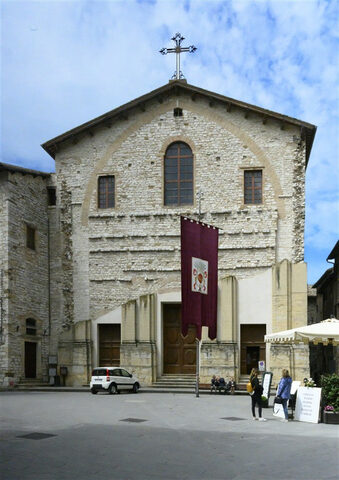
Chiesa di San DomenicoAbout 80 metres from the Enoteca, one of the neighbourhood's historic churches.

After the walk
A stop that's part of the visit.
After Piazza Grande, before the cable car, or on your way back from a walk, stop by the Enoteca. Have a well-chosen glass, ask for advice on wine, or get pointed toward a corner of Gubbio not to miss. For Alessandro, welcoming visitors to the city also means helping them get to know it better.
Come find us in San Martino